
Ashes and Olives: Psychiatry, Genocide, and the Arts in Palestine
This year’s World Mental Health Day carries the theme “Access to Services - Mental Health in Catastrophes and Emergencies.” Nowhere is this more urgent than in Gaza, where hospitals lie in ruins, medicines are blocked, and children cry themselves to sleep under bombardment. Psychiatry teaches that survival requires safety, community, and meaning - yet all three are under siege. This essay moves through disaster psychiatry, continuous traumatic stress, and the politics of memory to show how genocide erases not only bodies but also archives and culture. It recalls the looting of Palestinian libraries in 1948, the silencing of voices like Yaqeen Hammad and Anas al-Sharif, and contrasts their testimonies with the muted language of Western media. It also draws deeply from Palestinian poets, writers, and artists - Mahmoud Darwish, Fadwa Tuqan, Ghassan Kanafani, Sliman Mansour, MC Abdul - showing how art becomes both counter-archive and therapy, carrying memory when institutions collapse. What emerges is not only a critique of psychiatry’s limits but also a reminder: in catastrophes, memory itself is survival, and hope is an incurable act of resistance.
Anweshan Ghosh
9/16/202520 min read
Prologue
“On this earth, what makes life worth living:
the aroma of bread at dawn,
a woman’s point of view about men,
the works of Aeschylus,
the beginning of love,
grass on a stone,
mothers standing on a flute’s thread,
and the invaders’ fear of memories.”
- Mahmoud Darwish
Darwish’s words arrive like an incantation. He lists the fragile pleasures of life – bread, grass, the beginning of love – before ending with a sentence that curdles sweetness into terror: the invaders’ fear of memories. For what kind of power fears memory more than weapons? Only the power that knows it has built itself on erasure.
This line is less of a metaphor than a clinical observation. Psychiatry, when it concerns itself with trauma, is obsessed with memory: with how it is fragmented, intrusive, disavowed, returned in nightmares, crystallized in silence. Trauma is a disease of time, an affliction of remembrance. And in Palestine, the disease is not confined to individuals but distributed across a whole people.
Bread at dawn becomes smoke at noon. A woman’s voice becomes a scream in a hospital. Aeschylus’ tragedies feel almost redundant in a place where the ruins are not staged but real. And yet Darwish insists – there are still things that make life worth living. This insistence is both poetic and psychiatric: it is the stubborn survival of hope in the midst of disaster.
I. Disaster as a Normal State
“In this land we have what makes life worth living:
hesitation between two battles,
the scent of a woman coming from the sleep of distance,
and the invaders’ fear of songs.”
- Mahmoud Darwish, later version of the same poem
In the manuals of psychiatry, a disaster is defined as an extraordinary rupture: an earthquake, a flood, a war, a famine. It is meant to be an interruption in the normal flow of life. The discipline of disaster psychiatry studies what happens to minds and communities under such conditions – acute stress reactions, grief, dissociation, the cascade of trauma that follows catastrophe.
But what happens when catastrophe does not interrupt life but is life? Gaza, for decades, has been living inside disaster. The siege, the blockades, the cyclical bombardments, the repeated displacement – these are not ruptures but rhythms. They recur so often that they become the atmosphere itself, like humidity, like dust.
The principles of disaster psychiatry are familiar: provide safety, restore a sense of control, create stable routines, reconnect survivors to community, normalize reactions, and treat acute symptoms before they harden into chronic disorders. But each principle collapses in Gaza.
Safety? There is no safety when no place is beyond the reach of missiles. Control? Control is impossible when borders, food, electricity, even water are determined by an occupying power. Routine? Routines are broken by sudden displacement, by the loss of homes, schools, hospitals. Community? Communities themselves are bombed, fragmented, scattered into tents.
In most disasters, psychiatrists work with the assumption of aftermath. The storm passes, the earthquake ceases, the guns fall silent. Only then does the work of healing begin. But in Gaza, there is no aftermath. The storm is continuous. The earthquake repeats daily. The guns do not fall silent but pause, reload, resume.
This is why Palestinian clinicians and scholars speak of Continuous Traumatic Stress Disorder. The ordinary PTSD framework assumes that trauma belongs to the past, that it erupts as a memory into a safer present. In Gaza, the traumatic event is not remembered – it is happening. The nightmares of the night are indistinguishable from the bombardments of the morning.
Here psychiatry edges into poetry, whether it admits it or not. Because what is CTSD if not an echo of Darwish’s phrase – “the invaders’ fear of songs”? A condition in which memory cannot be sealed off from the present, in which every attempt to heal is sabotaged by fresh wounds?
Disaster psychiatry also emphasizes the importance of meaning. Survivors cope better when they can ascribe sense to their suffering, when their losses are framed within a narrative of purpose or resilience. But in genocide, meaning itself is under siege. The perpetrators do not merely kill; they delegitimize grief, they deny the dead, they erase the archive. What meaning is left when your library is stolen and stamped “Abandoned Property”? When your poet is assassinated, your child journalist bombed, your rapper silenced by blockade?
And yet, Palestinians insist on meaning. Darwish again: “We suffer from an incurable disease called hope.” In clinical terms, this might sound like denial. But in cultural terms, it is survival. Hope here is not optimism but defiance. To continue to love, to continue to sing, to continue to write, to continue to give bread to children under siege – these are acts of psychiatric resilience masquerading as daily life.
The irony is that psychiatry, in its manuals and scales, often cannot see this. It is too busy diagnosing depression, quantifying anxiety, calculating prevalence. It counts symptoms as Arena counts bodies, as The Lancet projects tolls: usefully, but incompletely. It does not hear what Darwish hears: that even in ruins, there is grass on stone, bread at dawn, mothers on a flute’s thread.
II. The Politics of Counting and the Numbing of Minds
“The cause of death was suffocation.
But in truth it was silence.”
- Ghassan Kanafani, Men in the Sun
There is a strange arithmetic of catastrophe. When the numbers are small – a child named Yaqeen, a journalist named Anas – hearts ignite. When the numbers swell to tens of thousands, they dull. Paul Slovic, the psychologist of risk, called this psychic numbing: the larger the tragedy, the less we feel. The curve of compassion does not ascend with numbers; it flattens, collapses. A million dead are less moving than one.
This is what Jenni and Loewenstein described in their work on the identifiable victim effect: we weep for the single face, the named child, the visible wound, but the faceless crowd leaves us cold. Western coverage of Gaza has been caught in this paradox. The Lancet’s projection of 186,000 deaths should stagger the conscience; instead it hovers like an abstraction. Meanwhile, the image of a single child pulled from rubble, her name intact, pierces us.
Psychiatry knows this pattern well. The mind defends itself against too much horror by numbing, by withdrawing. But the arts resist this defense. Darwish’s poetry, Kanafani’s stories, Mansour’s paintings – they take the abstract “dead” and give them names, textures, memories. Where statistics paralyze, metaphors ignite. Where psychic numbing deadens, art awakens.
Yet the silence Kanafani described is not only psychic but political. Arena’s Politics of Counting Gaza’s Dead reminds us that bodies are not just lost but miscounted, mislabeled, denied. Death is not only erasure but manipulation. Counting itself becomes a weapon. To minimize is to absolve; to inflate without naming is to dehumanize.
Psychiatry counts symptoms. Politics counts bodies. Art counts memories: one poem, one olive tree, one child named Yaqeen. Each kind of counting matters. But only the last resists numbness.
III. Cognitive Dissonance and the Camel of Hardship
“If the olive trees knew the hands that planted them,
their oil would become tears.”
- Mahmoud Darwish
There is a peculiar irony at the heart of this genocide. The state that calls itself Jewish, born from the ashes of the Holocaust, now wages war with the same rhetoric of extermination once used against Jews. To resolve the unbearable contradiction, defenders invoke cognitive dissonance: they label victims “terrorists,” they call rubble “collateral,” they speak of genocide as “self-defense.”
This is not new. History is thick with perpetrators who transformed atrocity into virtue. At Nuremberg, Nazi defendants insisted they were “following orders” to preserve civilization. In the American South, Klansmen spoke of lynching as a defense of Christian morality. In India, upper caste perpetrators justified massacres of Dalits as upholding social order. Always, the same pattern: atrocity wrapped in moral necessity, cruelty disguised as protection.
Psychiatry teaches us that cognitive dissonance is not a rare pathology but a universal mechanism. When belief collides with action, the mind chooses comfort over truth. And when societies collude, consensus forms around the lie.
Sliman Mansour’s Camel of Hardship embodies the opposite. Painted in 1974, it shows a bent figure hauling a massive load: Jerusalem’s Dome of the Rock, villages, olive groves, and the whole weight of Palestine strapped to his back. There are no illusions here, no dissonance softened by euphemism. The suffering is naked, the endurance literal. Mansour once said that painting was “a way of resisting disappearance.” The camel carries the land not because it is noble but because there is no choice.
Art, unlike propaganda, does not rationalize. It bears weight. It refuses dissonance. It insists on seeing.
IV. Children as Witnesses: Yaqeen and Abdul
“My younger brother and sister cry at night from the bombs, and my mom tells them it’s just firecrackers.”
- MC Abdul
“Despite the war and the genocide, we came here to bring joy to the children.”
- Yaqeen Hammad, video posted May 2025
“My baby sister – is this something she deserves?
Growing up in a world where she’s not treated the same,
Denied the right to live free.”
- MC Abdul
Yaqeen Hammad was eleven years old. On the night of 23 May 2025, Israeli airstrikes hit Al-Baraka, Deir al-Balah, central Gaza – a crowded neighbourhood where hundreds of displaced families were sheltering. Her family home, constructed hastily of concrete blocks and corrugated tin, collapsed under the blast. According to reports, Yaqeen and several members of her family were buried in the rubble. Rescuers found her remains after hours of digging, amid broken beams and household debris. She had no time to flee.
In her final video, made just a few days earlier, she stood amid tents and dust. Her voice was gentle:
“In spite of the war, in spite of everything, we came here to bring joy to the children. Even a small smile matters.”
Other videos captured her delivering food and toys to young children in the shelter. She showed how to purify water using charcoal, how to cook using leftover wood when gas was cut. Every clip was an act of kindness turned into digital memory. Then came the blast, and houses, laughter, hope turned to silence.
Her death was not abstract. She died in her bed, her body pressed against broken walls and shattered glass. Her presence is preserved only in pixelated videos: a child’s smile flickering on mobile screens. She gave joy, and then she was gone, like bread at dawn turned to ash before the day began.
Beside her memory stands the younger artist Abdel-Rahman Al-Shantti – known as MC Abdul. At nine, he rapped:
“I was born in Gaza City,
the strip where I was raised,
where missiles fly above me,
and bombs block out the days.
I want to live in peace,
but peace won’t live with me.
They say freedom has a price,
we’re paying endlessly.”
He posted snippets – his voice shaking in places, steady in others – chanting over a beat he recorded with a phone and a borrowed mic. He became a symbol: a child whose rhyme is both prayer and protest. His words, unlike the walls that tried to silence him, persist.
V. The Journalist as Martyr and the Muting of Agency in Headlines
“If these words reach you, Israel has succeeded in killing me and silencing my voice.”
- Anas al-Sharif, final message
Anas al-Sharif was killed on 10 August 2025, when an Israeli airstrike hit a tent where journalists were gathered outside Al-Shifa Hospital in Gaza City. Among the dead was Anas himself, one of the clearest-eyed narrators of a people under siege. He did not simply witness suffering; he named its source.
Yet many Western media headlines that covered his death, while acknowledging the tragedy, muted the agency behind it.
For instance, in headlines from Western outlets around that time:
“Several journalists killed in Gaza hospitals after overnight strikes” (BBC News, 11 August 2025) – “after overnight strikes” divorces the action from the actor.
“Media workers among many dead in fresh Gaza bombing” (AP News, 11 August 2025) – “Gaza bombing” feels passive; responsibility is unspecified.
“Violence continues to take its toll on press in Gaza” (The New York Times, 12 August 2025) – "violence continues" veils who is committing it.
By contrast, when the war in Ukraine broke out, headlines named the aggressor directly:
“Russia invades Ukraine: Kyiv under attack as Vladimir Putin unleashes 'special military operation'” (The Guardian, 24 February 2022)
“Russian missile strikes kill dozens in Kyiv residential district” (Reuters, 18 March 2022)
“Ukraine accuses Russia of war crimes after bombing of hospital” (CNN, 9 March 2022)
In those Ukrainian headlines, the subject is clear: Russia bombs, invades, kills. The aggressor is visible; agency is not neutralized. In the Gaza figure-line, language tends to rotate around the attack without naming the attacker.
Media language is not merely style; it shapes collective conscience. When “strikes” evaporate into “overnight attacks,” when “violence” abstracts the agent, the story drifts toward moral numbness. When Anas’s death is framed as happenstance – journalists caught in violence – it softens Israel’s role, making it part of “ongoing violence,” rather than lethal policy.
Anas’s journalism, in contrast, refused evasion. He filmed pregnant women in collapse, children wailing under rubble, streets drowned in blood. He named Israel on camera, in articles, in social media. His final message was a condemnation crafted before his death, a testament not only of his life but of his refusal to let headlines detach him from humanity.
Anas had left behind a message, prepared earlier:
“If these words reach you, know that Israel has succeeded in killing me and silencing my voice. I have lived through pain in all its details, tasted suffering and loss many times, yet I never once hesitated to convey the truth as it is, without distortion or falsification. Do not forget Gaza... And do not forget me in your sincere prayers for forgiveness and acceptance.”
VI. Labyrinths and Consensus
“Handala will remain ten years old until he returns. Only then will he grow up.”
- Naji al-Ali
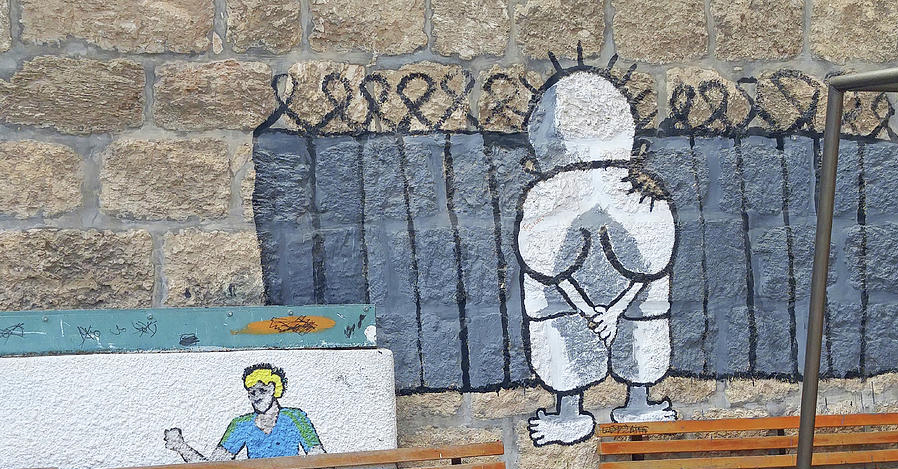
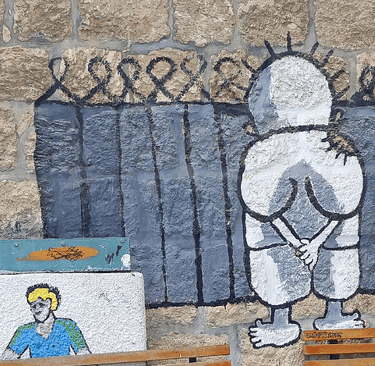
Handala, the barefoot child with his back turned, embodies the psychiatric condition of frozen trauma. He will not age until return, he will not turn his face until justice. In clinical language, he is the dissociated child self, development arrested by violence. In artistic language, he is Palestine itself: small, stubborn, wounded, refusing erasure.
Borges once wrote of labyrinths that repeat themselves, endless corridors leading back to the same room. In Palestine, the labyrinth is generational: 1948, 1967, 1982, 2009, 2014, 2021, 2023, 2024, 2025 – each war an iteration, each ceasefire a cul-de-sac. Children become parents who raise children in tents, each generation inheriting the same map of rubble.
Western liberal societies watch this labyrinth and practice their own psychic defenses. Here cognitive dissonance takes collective form. To preserve the image of Israel as a democracy, to safeguard their own moral self-image as defenders of human rights, they construct elaborate rationalizations. They say: “It is complicated.” They say: “Both sides are to blame.” They say: “Israel has the right to defend itself.”
But in the same breath they speak of Ukraine with clarity: “Russia invaded. Russia bombed. Russia is guilty.” There is no labyrinth here, no frozen child. The dissonance is glaring. To resolve it, Western publics retreat into abstractions. The genocide is reframed as “conflict.” Civilians are not “killed by Israel” but “caught in crossfire.” Consensus forms not in truth but in euphemism.
This consensus is as dangerous as bombs. It anesthetizes conscience, diffuses outrage, allows the labyrinth to go on without exit.
VII. Psychiatry’s Complicity and Limits
“The world is not a courtroom, but a field of execution…
and we are the accused.”
- Samih al-Qasim
Psychiatry is a discipline of paradox: it has healed and it has colluded, it has named suffering and it has turned crimes into symptoms. The history is blunt and instructive. In the Nazi era, psychiatrists were not merely neutral scientists; some provided “scientific” rationales for extermination programs and took part in assessing who was considered fit to live. The ethical collapse of psychiatry under Nazism remains a touchstone in medical ethics and is the subject of extensive literature and reflection.
Another story of historical absurdity was the invention of drapetomania in 1851 – a pseudo-diagnosis that medicalized an enslaved person’s flight from bondage. Cartwright’s claim that enslaved people who fled were suffering from a mental illness is an archetypal example of how psychiatric language has been used to naturalize oppression. These episodes are not curiosities of a distant past: they are cautionary parables about how clinical categories can be pressed into the service of power.
In the occupied Palestinian territories, these historical lessons are immediately relevant. There are two ways psychiatry can err here. The first is omission: refusing to name political violence as a cause of distress. The second is depoliticization: translating a population’s rational reaction to occupation, siege, and systematic deprivation into an individual disorder detached from its root causes. Both mistakes are visible in the literature and in practice.
A growing critical literature argues that international humanitarian and mental-health responses frequently de-politicize suffering in Palestine, framing distress as clinical pathology while obscuring the structural and human-rights conditions that produce it. This critique is not rhetorical alone – it is empirical. Reviews and commentary published in psychiatric and public-health journals call for a human-rights approach that connects mental-health work to political context and accountability.
Clinically, Gaza’s situation exposes the limits of standard diagnostic frames. Traditional PTSD models assume an identifiable traumatic exposure followed by (at least some) safety. In Gaza, clinicians and researchers describe Continuous Traumatic Stress (CTS) or Continuous Traumatic Stress Disorder (CTSD) to capture the lived reality: threat is not only historic but imminent and ongoing. CTSD reorients care: stabilization shifts from processing past events to strategies for surviving current, repeated threats – managing hypervigilance while there is still cause for vigilance. The literature on CTSD in Palestine draws on field studies and clinical observation and argues that therapeutic models must shift accordingly.
Epidemiology reinforces the clinical urgency. Multiple peer-reviewed studies and NGO rapid assessments document very high rates of probable PTSD, anxiety, and depression in Gaza — particularly among children. School-based surveys, clinic samples, and community needs assessments report prevalence estimates that commonly cluster in the tens of percentage points, and in specific cohorts exceed 40–50% for PTSD symptoms. Large humanitarian reports and WHO situation updates further document the systemic destruction of health infrastructure, massive numbers of injured people requiring long-term rehabilitation, and sharply constrained access to basic medicines and mental-health services. These are not statistics in the abstract: they are the operating conditions in which any psychiatric intervention must function.
Given this evidence, the ethical responsibility for psychiatrists and mental-health professionals is threefold. First, clinicians must avoid pathologizing justified suffering – labeling reasonable fear, grief, and resistance as individual psychopathology without acknowledging political causation. Scholars have explicitly warned against such depoliticization and urged that mental-health practice in the oPt be embedded in a rights-based framework.
Second, psychiatry must adapt its interventions to the realities of continuous threat. Where safety is absent, traditional trauma therapies that require prolonged exposure to narrative integration or stable settings are often impractical or even harmful. Instead, scalable, low-resource interventions focused on psychological first aid, community psychosocial support, school-based programs, and culturally resonant arts-based modalities have clearer evidence of feasibility and benefit in Gaza-like settings. Field reviews find that locally led, community-based programs (including arts and culture) improve functioning and reduce distress more reliably than imported individual psychotherapies that presuppose safety.
Third, psychiatry must be an ally for accountability. Naming continuous trauma, documenting patterns of population-level harm, and linking mental-health indicators to violations of rights is not “political” in the pejorative sense; it is part of clinical truth-telling. When headlines and some Western reporting obscure perpetrator agency, when humanitarian metrics are neutralized into passive “numbers,” psychiatric testimony can keep sight of causality – that bombardment, blockade, and policy decisions are proximate causes of the population’s suffering. Doing so is uncomfortable, but essential to an ethics of care that refuses to sanitize injustice into a checklist of symptoms.
There are practical and methodological challenges to such a stance. Research in conflict zones faces sampling biases, ethical constraints, and threats to participants and staff. Humanitarian services operate under funding pressures and political scrutiny. Yet these are reasons for rigor and solidarity, not neutrality. The alternative – clinical silence or decontextualization – reproduces harm by default.
Finally, psychiatry’s limits must be candidly acknowledged. Medications and diagnosis cannot rebuild hospitals, provide food or restore water. Psychiatry cannot mend the social fabric. But psychiatry can witness, document, and design interventions that respect cultural practices, amplify local protective factors (ritual, poetry, community support), and insist that mental health policy be inseparable from rights and reconstruction. In Gaza, the most effective psychiatric practices will be those that partner with artists, teachers, community leaders and rights advocates; not those that pretend the clinic is a sufficiently isolated instrument of healing.
In short: psychiatry must refuse the role of neutralizer. It must name causes, adapt practice to continuous threat, and ally with memory and justice. Anything less risks being a medical balm applied to a wound that politics and human rights are responsible for opening.
VIII. The Genocide of Memory
“The invaders fear of memories.”
- Mahmoud Darwish
Genocide is not only the killing of bodies but the erasure of memory. In 1948, as Palestinians were driven from their homes and villages torched, Israeli forces entered not only to conquer but to collect. They seized some 70,000 books: Qur’ans, novels, poetry, family libraries, Ottoman registers, notebooks, philosophical treatises, cookbooks, prayer books. Each was stamped AP – Abandoned Property – and deposited in the Jewish National Library in Jerusalem. Some were catalogued, others pulped, many simply vanished.
Ilan Pappé names this act memoricide. Gish Amit traces how librarians themselves became agents of erasure, their catalogues transformed into cemeteries of the Palestinian word. Nur Masalha describes how the archive was inverted: Palestinian memory rebranded as Israeli trophy, stripped of context, preserved as relic rather than living heritage. Families who returned to search for their libraries were told nothing. The AP stamp was a lie; the property was not abandoned but stolen from those expelled at gunpoint.
Psychiatry has a term for this kind of wound: collective identity trauma. Survivors lose not only loved ones but the symbolic anchors of self – language, books, rituals. When books burn, memory burns with them. Memoricide is not simply forgetting; it is forced amnesia, doubled trauma: first the violence itself, then the denial that memory ever existed.
Darwish wrote:
“Write down!
I am an Arab.
I have a name without a title.
Patient in a country
where everything lives in a whirlpool of anger…
You have stolen the orchard of my ancestors
and the land I cultivated with my children,
and left me nothing
but these rocks.
So will your government, as people claim,
take them too,
as it has been said?”
Indigenous peoples in the Americas, First Nations in Australia, colonized communities across the globe bear similar scars. Languages banned, children forced into foreign schools, oral traditions mocked – the result is grief compounded by disorientation, a rupture in continuity that erodes the sense of belonging.
In Palestine, memoricide compounds displacement. To be exiled is to lose land; to be looted is to lose past. Together they create a condition we might call traumatic timelessness: without archive, without anchor, survivors float between grief and erasure.
The irony deepens when we recall European history. The perpetrators of this memoricide are heirs to a trauma of their own: synagogues torched in Berlin, Hebrew libraries looted in Vienna, Jewish texts consigned to flames in Warsaw. In 1933, Nazis staged bonfires in Berlin, destroying Freud and Marx alongside Torah commentaries. Jewish families watched centuries of scholarship turn to ash. To inherit that history and reenact it upon another people is a grotesque inversion. Psychiatry calls it displacement – the redirection of one’s own wound into violence against another. Politics calls it hypocrisy. Poetry calls it tragedy.
Darwish foresaw it in a single line: “If the olive trees knew the hands that planted them, their oil would become tears.” The olive knows that history repeats in twisted forms. The archive of Jewish suffering, instead of engendering solidarity, was weaponized to justify new erasures.
And yet memory resists. In Gaza, even when libraries are rubble, poems are recited aloud. Elders teach children verses from Darwish by heart: “On this earth, what makes life worth living…” Fadwa Tuqan’s laments are whispered in kitchens.
Ghassan Kanafani’s Men in the Sun carries this tragedy in allegory. Three Palestinian refugees suffocate in a sealed water tanker, their voices unheard. The driver, discovering their corpses, screams: “Why didn’t you knock on the sides of the tank? Why didn’t you knock? Why? Why? Why?” Retold in exile camps as parable and prophecy, the silence lives on.
Visual artists painted what books could no longer preserve. Sliman Mansour’s Camel of Hardship became a manuscript in oils: a bent figure carrying Jerusalem’s Dome of the Rock, olive trees, villages; the entire land strapped to his back. Graffiti too became scripture. Naji al-Ali’s Handala appeared on walls from Beirut to Amman, a child forever turned away, barefoot, refusing to grow until return. His silent defiance was copied endlessly, until he became a canon of exile.
Music carried memory across borders. Marcel Khalife set Darwish to melody:
“O mother, I am the exile,
returning to your arms,
but your embrace is ashes,
and your lap is rubble.”
Hip-hop became a new archive: MC Abdul looping ancestral pain into rhyme, uploading it to platforms no missile could fully silence.
Thus Palestinians created what might be called counter-archives: dispersed, oral, musical, visual, embodied. Fragile, yet indestructible. They exist not only in libraries but in memory, voice, and gesture. No catalogue can contain them, no army can seize them.
Epilogue: The Incurable Disease Called Hope
“We suffer from an incurable disease called hope.”
- Mahmoud Darwish
Genocide seeks to turn hope into pathology. It wishes to make memory burdensome, song futile, resistance absurd. And yet hope, in Palestine, endures not as optimism but as defiance – incurable, contagious, unyielding.
Samih al-Qasim once wrote from his prison cell:
“I may lose my livelihood,
I may lose my son,
my daughter,
my wife,
my brothers and sisters,
I may lose my friends,
I may lose my freedom,
I may lose my life…
but I shall not lose my will to resist,
and if I die
I shall die with a smile.”
This is not clinical resilience; it is existential rebellion. Disaster psychiatry might call it a protective factor. Poetry calls it survival itself.
Fadwa Tuqan, in exile, promised:
“The day will come when I shall recover myself,
and I will return as a bird of song,
hovering over my homeland,
singing of love and freedom.”
Her vow is less prediction than enchantment: a way of writing herself, and her people, back into existence.
And Darwish, in a line that has become scripture:
“On this earth what makes life worth living:
the aroma of bread at dawn,
mothers on a flute’s thread,
and the invaders’ fear of memories.”
Bread, mothers, memory – fragile, ordinary, immortal.
Even now, in the rubble of Gaza, bread is baked on improvised stoves, mothers cradle children in tents, memories are passed hand to hand like contraband. Yaqeen Hammad’s videos remain online; Anas al-Sharif’s final words circulate in headlines; MC Abdul’s verses stream in headphones across the globe. Each is an ember against the dark.
Genocide is efficient at silencing, but memory whispers louder. It resists erasure by multiplying. Each time a verse is recited, each time Handala is drawn on a wall, each time a rap is uploaded, the archive of Palestine grows.
Disaster psychiatry teaches that recovery demands safety, continuity and meaning. Gaza has none of these. Continuous traumatic stress shows that when violence never ends, trauma itself becomes time. Cognitive dissonance explains how the world rationalizes its complicity, how Western liberalism names Russian atrocities but mutes Israeli ones. Psychiatry, in Gaza, cannot heal, but it can witness – and in naming continuous trauma, it aligns itself, finally, with the poets.
The epilogue, then, is not an ending but an insistence: that even amid ash and absence, there is bread, there is song, there is hope. Hope not as cure, but as disease – incurable, spreading across generations, immune to siege.
Darwish’s words, Tuqan’s vows, al-Qasim’s defiance, Abdul’s rhymes, Yaqeen’s smile, Anas’s testimony – together they form the last truth: that memory itself is resistance, and that resistance itself is life.
REFERENCES
A. Academic Articles & Reports (Psychiatry, Trauma, Mental Health)
Abudayya, Amin. 2023. “Mental Health of Palestinian Children and Young People: A Scoping Review.” Children and Youth Services Review (2023), https://doi.org/10.1016/j.childyouth.2023.106774; [ScienceDirect].
El-Khodary, Buthaina and Monira Samara. 2020. “Traumatic Events and PTSD Among Palestinian Children and Adolescents: The Effect of Demographic and Socioeconomic Factors.” Frontiers in Psychiatry 11 (January). https://doi.org/10.3389/fpsyt.2020.00004; [Frontiers in].
Farajallah, Iman. 2022. “Continuous Traumatic Stress in Palestine: The Psychological Implications.” World Psychiatry (or Wiley-Psychiatry Journal) – article on CTSD in Palestine; https://doi.org/10.100A. Academic Articles & Reports (Psychiatry, Trauma, Mental Health)
Helbich, M., et al. 2022. “Social Justice and a Human Rights Approach to Mental Health in Palestine.” International Journal of Mental Health Systems, Vol. XX. https://doi.org/10.1186/s13033-022-00586-2; [PMC].
World Health Organization (WHO). 2025. “Operational Response and Early Recovery Plan for oPt, 2025.” Eastern Mediterranean Regional Office. https://www.emro.who.int/images/stories/palestine/WHO-operational-response-and-early-recovery-plan-for-oPt-2025.pdf.
WHO. 2024. “Emergency Situation Reports — Occupied Palestinian Territory.” WHO EMRO website. https://www.emro.who.int/opt/information-resources/emergency-situation-reports.html.
Marie, M., et al. 2020. “Anxiety Disorders and PTSD in Palestine: A Literature Review.” Children and Youth Services Review, 116 (December). https://www.ncbi.nlm.nih.gov/pmc/articles/PMC7566157/.
War Child / NGO consortium. 2024. “Mental Health Needs in Gaza: Rapid Assessment Report.” The Guardian, 11 December 2024. https://www.theguardian.com/world/2024/dec/11/death-feels-imminent-for-96-of-children-in-gaza-study-finds.
Slovic, Paul. 2007. “If I Look at the Mass I Will Never Act: Psychic Numbing and Genocide.” Judgment and Decision Making 2 (2): 79–95.
Jenni, Kerry and George Loewenstein. 1997. “Explaining the "Identifiable Victim Effect”.” Journal of Risk and Uncertainty 14: 235–257.
Lee, Kirby and Jessica Feeley. 2016. “The identifiable victim effect: a meta-analytic review.” Social Influence 11 (3): 199–215.
B. Genocide, Memory, Memoricide, and Palestinian Archive
Pappé, Ilan. 2006. The Ethnic Cleansing of Palestine. Oneworld Publications.
Amit, Gish. 2014. Archives des Palestiniens: Histoire, mémoire et dépouillements. Éditions L’Harmattan. (Translated title: Archives of the Palestinians: History, Memory and Spoils.)
Masalha, Nur. 2018. The Palestine Nakba: Decolonising History, Narrating the Subaltern, Reclaiming Memory. Zed Books.
C. Poetry, Fiction, and Cultural Works
Darwish, Mahmoud. 1979. Unfortunately, It Was Paradise: Selected Poems. Translated by Munir Akash and Carolyn Forché. Harper & Row.
Tuqan, Fadwa. 1986. A Mountainous Journey: The Complete Poetry. Olive Branch Press.
Kanafani, Ghassan. 1963. Men in the Sun and Other Palestinian Stories. Translated by Hilary Kilpatrick. Three Continents Press.
Al-Ali, Naji. (Cartoons). “Handala” series, 1960s-1980s. (Reference to visual symbol.)
D. News Reports and Inquiries
Reuters. 2025. “UN Inquiry Finds Top Israeli Officials Incited Genocide in Gaza.” Reuters, 16 September 2025. https://www.reuters.com/world/middle-east/un-inquiry-finds-top-israeli-officials-incited-genocide-gaza-2025-09-16.
Al Jazeera. 2024. “Gaza Toll Could Exceed 186,000, Lancet Study Says.” Al Jazeera, 8 July 2024. https://www.aljazeera.com/news/2024/7/8/gaza-toll-could-exceed-186000-lancet-study-says.
Arena Magazine. 2024. “The Politics of Counting Gaza’s Dead.” Arena.org.au, date accessed. https://arena.org.au/politics-of-counting-gazas-dead/.
E. Media Reporting on Yaqeen, Anas, MC Abdul
The Guardian. 2025. “Gaza’s youngest influencer, aged 11, among children killed by Israeli strikes.” The Guardian, 26 May 2025. https://www.theguardian.com/world/2025/may/26/gazas-youngest-influencer-aged-11-among-children-killed-by-israeli-strikes.
Al Jazeera. 2025. “Al-Jazeera journalist Anas al-Sharif killed in Israeli attack in Gaza City.” Al Jazeera, 10 August 2025. https://www.aljazeera.com/news/2025/8/10/al-jazeera-journalist-anas-al-sharif-killed-in-israeli-attack-in-gaza-city.
TBS News. 2022. “Meet MC Abdul, Young Palestinian Rapper Who Echoes the Agony of Occupied Palestine.” TBS News, August 2022. https://www.tbsnews.net/splash/meet-mc-abdul-young-palestinian-rapper-who-echoes-agony-occupied-palestine-429210.